做 CppQuiz ,总结一下错题
计数器:
21 / 163
1 2 3 4 5 6 7 8 9 10 11 12 13 14 15 #include <iostream> void f (float &&) "f" ; }void f (int &&) "i" ; }template <typename ... T>void g (T &&... v) (f (v), ...); } int main () g (1.0f , 2 ); }
右值引用本身是左值,但是在隐式转换后就变成了 prvalue
1 2 3 4 5 6 7 8 9 10 11 12 #include <iostream> using namespace std;template <typename T>struct A { static_assert (false ); }; int main () cout << 1 ; }
与模版参数推导无关的 ill-form 会导致整个程序 ill-from ,是UB
1 2 3 4 5 6 7 8 9 10 11 12 #include <iostream> template <typename T>void foo (T...) 'A' ;}template <typename ... T>void foo (T...) 'B' ;}int main () foo (1 ); foo (1 ,2 ); }
上面那个是 C 风格的 va_list ,下面那个才是参数包
对于 foo(1)
两个都不需要隐式转换
如果推导 A 可以被传入推导 B 中,那么推导 A 是一个更特化的推导。如果分不出来,就是 ill-form
对于 foo(1, 2)
第一个函数需要将第二个参数隐式转换为 ... ,而第二个不需要,所以第二个更好
1 2 3 4 5 6 7 #include <iostream> volatile int a;int main () std::cout << (a + a); }
读 volatile glvalue 有 side-effect
顺序不确定的对同一个内存做有 side-effect 的访问是 UB
1 2 3 4 5 6 7 8 9 10 11 12 13 14 15 #include <iostream> template <class T>void f (T) 1 ; }template <>void f<>(int *) { std::cout << 2 ; }template <class T>void f (T*) 3 ; }int main () int *p = nullptr ; f ( p ); }
T* 可以传入 T 中,反过来不行,所以 T* 更加特化
而重载决议先考虑模版,再考虑显式特化,所以模版函数 f(T) 的特化 f<>(int*) 不被考虑
1 2 3 4 5 6 7 8 9 10 11 12 13 14 15 16 17 18 19 #include <iostream> #include <type_traits> void g (int &) 'L' ; }void g (int &&) 'R' ; }template <typename T>void f (T&& t) if (std::is_same_v<T, int >) { std::cout << 1 ; } if (std::is_same_v<T, int &>) { std::cout << 2 ; } if (std::is_same_v<T, int &&>) { std::cout << 3 ; } g (std::forward<T>(t)); } int main () f (42 ); int i = 0 ; f (i); }
42: rvalue ,T 推导为 int
i: lvalue ,T 推导为 int&
1 2 3 4 5 6 7 8 9 10 11 12 13 14 15 #include <iostream> struct Base { void f (int ) "i" ; } }; struct Derived : Base { void f (double ) "d" ; } }; int main () Derived d; int i = 0 ; d.f (i); }
派生类隐藏基类的同名函数
1 2 3 4 5 6 7 8 9 10 11 12 13 14 15 #include <iostream> typedef long long ll;void foo (unsigned ll) std::cout << "1" ; } void foo (unsigned long long ) std::cout << "2" ; } int main () foo (2ull ); }
ll 会被优先解释为一个 unsigned 变量
有空看看这个的3~4条
1 2 3 4 5 6 7 8 #include <iostream> int main () int i = 1 ; int const & a = i > 0 ? i : 1 ; i = 2 ; std::cout << i << a; }
条件表达式的返回值的左右性取决于这个的2~5条 ,本题中 i 是 lvalue ,1 是 prvalue ,返回值为 prvalue
1 2 3 4 5 6 7 8 9 10 11 12 13 14 15 16 17 18 #include <cstddef> #include <iostream> void f (void *) std::cout << 1 ; } void f (std::nullptr_t ) std::cout << 2 ; } int main () int * a{}; f (a); f (nullptr ); f (NULL ); }
nullprr 的类型是 std::nullptr_t 的 prvalue
但是 NULL 的定义并不确定,可以是 int long std::nullptr_t 想不到吧
1 2 3 4 5 6 7 8 9 #include <iostream> #include <sstream> int main () std::stringstream ss ("a" ) ; std::cout << ss.str (); ss << "b" ; std::cout << ss.str (); }
stringstream 不传参数的情况下默认从开头开始,会覆盖原有数据
1 2 3 4 5 6 #include <iostream> int main () int a = 5 ,b = 2 ; std::cout << a+++++b; }
对符号的识别是接受尽可能长的字符,即使可能导致剩下的符号无法识别
1 2 3 4 5 6 7 8 9 10 11 12 13 14 15 #include <iostream> struct X { X () { std::cout << "1" ; } X (const X &) { std::cout << "3" ; } ~X () { std::cout << "2" ; } void f () "4" ; } } object; int main () X (object); object.f (); }
“所有会被识别为声明的东西都会被识别为声明”
所以 X(object) 实际上声明了一个类型为 X 的 object, 而不是拷贝构造了一个临时变量
想不到吧
An expression-statement with a function-style explicit type conversion as its leftmost subexpression can be indistinguishable from a declaration where the first declarator starts with a (. In those cases the statement is a declaration.
src
1 2 3 4 5 6 7 8 9 10 11 12 13 14 15 16 #include <type_traits> #include <iostream> using namespace std;struct X { int f () const && return 0 ; } }; int main () auto ptr = &X::f; cout << is_same_v<decltype (ptr), int ()> << is_same_v<decltype (ptr), int (X::*)()>; }
返回值 参数列表 左右值引用修饰符 cv修饰符 异常 都是函数的一部分
1 2 3 4 5 6 7 8 9 10 11 12 13 14 15 16 #include <iostream> class C {public : explicit C (int ) std::cout << "i" ; } C (double ) { std::cout << "d" ; } }; int main () C c1 (7 ) ; C c2 = 7 ; }
这个题其实挺蛋疼的, 也解释了做题的必要性, 有的东西光看了学了真不一定能搞明白; 甚至做题没做仔细没仔细看自己和答案的过程差在哪, 都可能把盲点放过去…因为过程错了结果说不定还是对的
比如我第一次做这个题的时候以为在考构造函数
其实是考初始化
我之前甚至都没注意到初始化这么个和吃饭喝水一样平常的东西
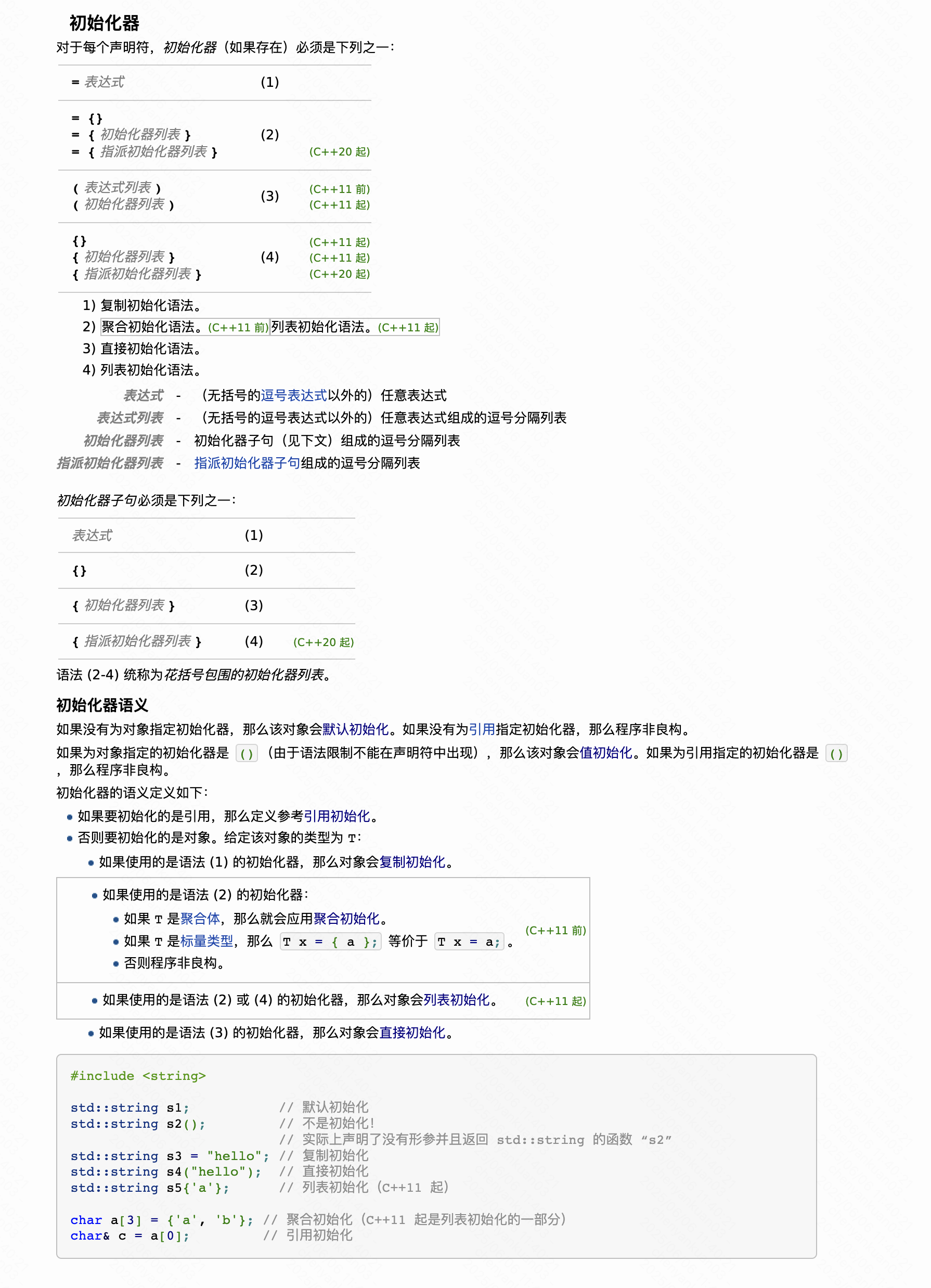
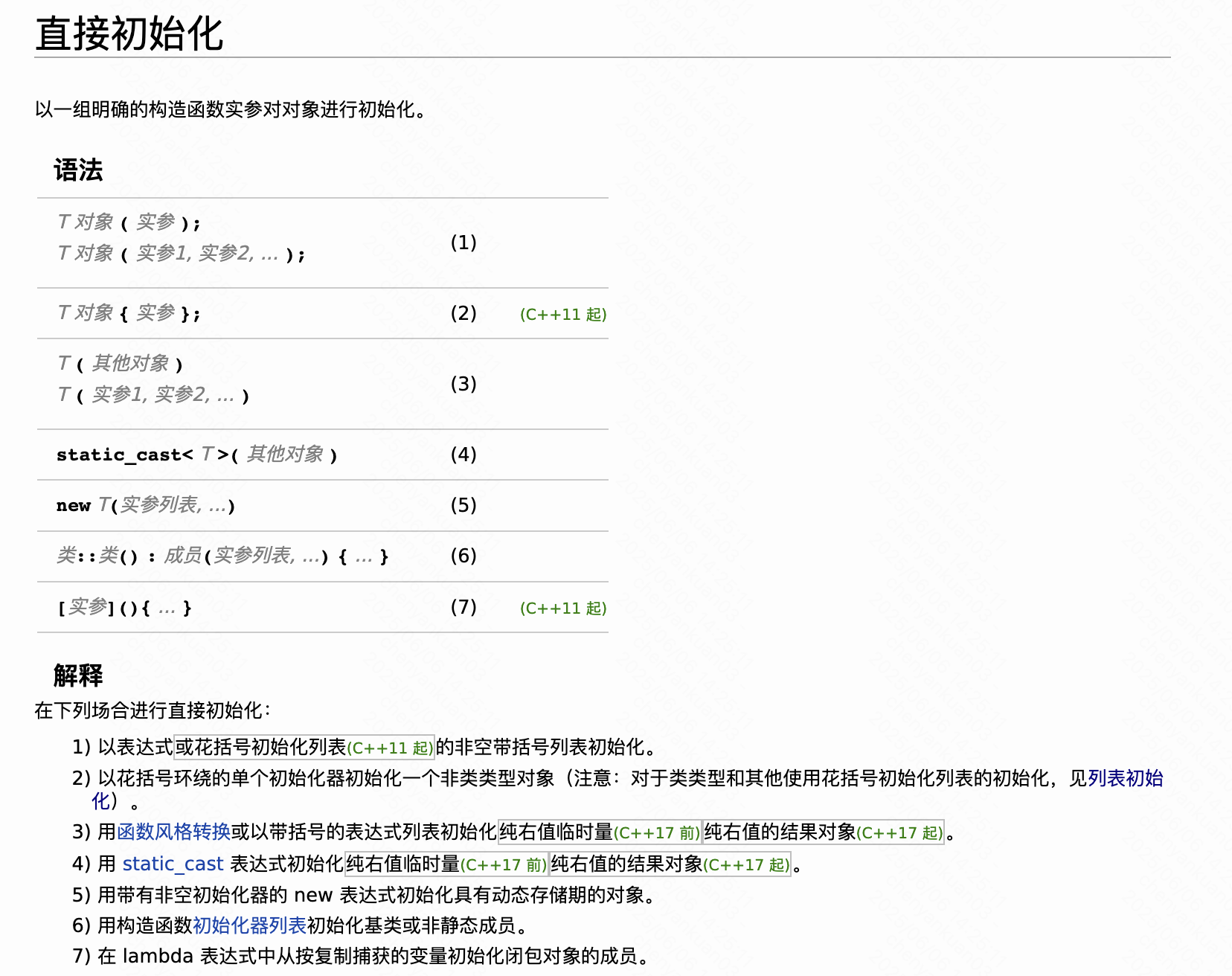
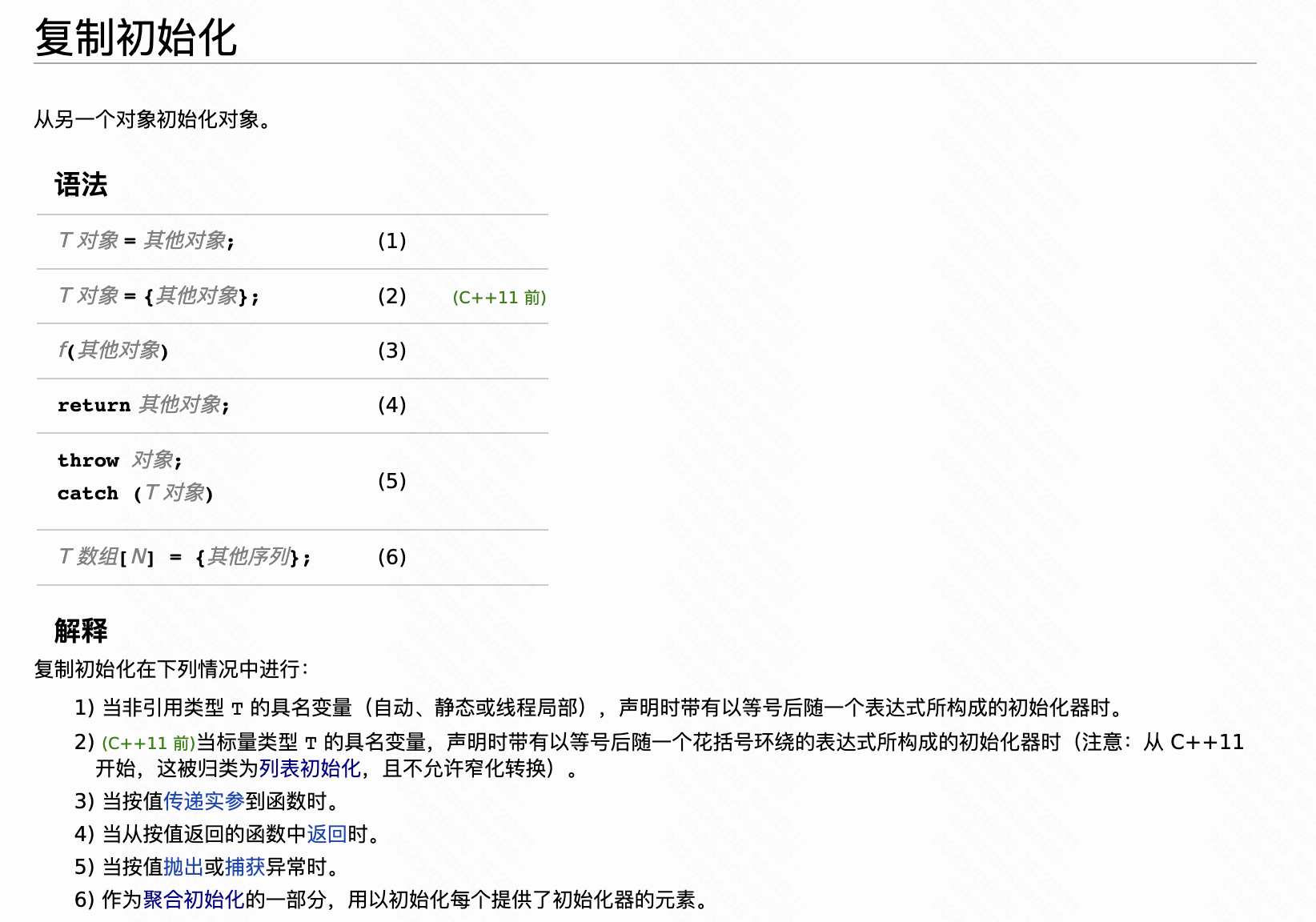
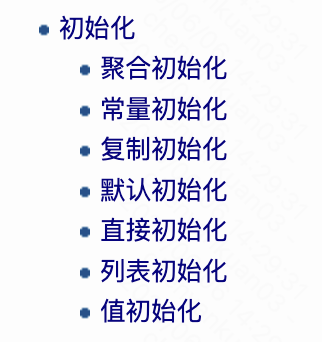
默认初始化不等于默认构造函数, 拷贝初始化不等于拷贝构造函数
简单来说就是下面这坨
然后复制初始化只考虑转换构造函数 (没有 explicit 修饰的), 而直接初始化考虑
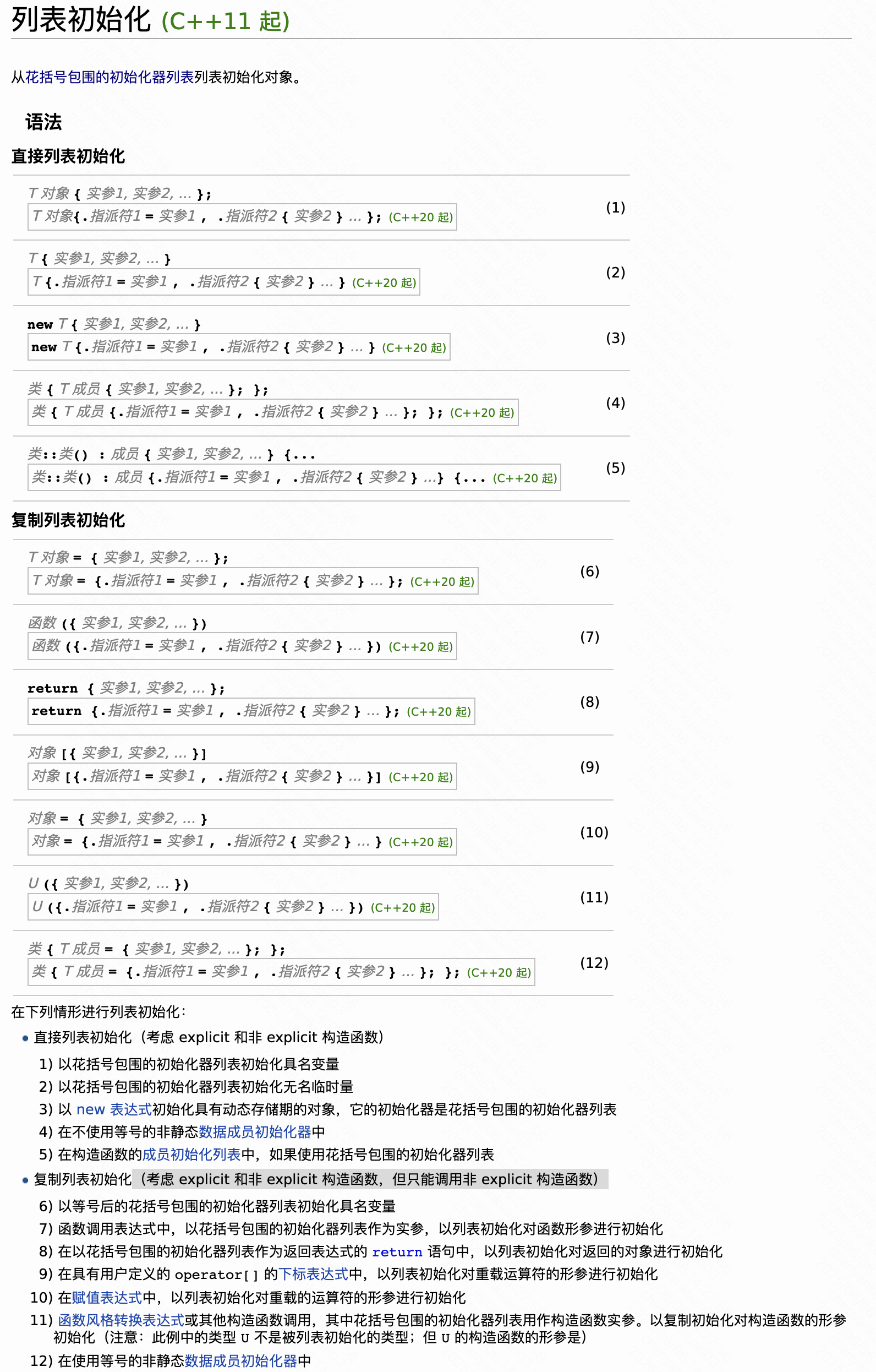
列表初始化分直接列表初始化(考虑 explicit 和非 explicit 构造函数)和复制列表初始化(考虑 explicit 和非 explicit 构造函数,但只能调用非 explicit 构造函数 (有点没懂, 那这里的考虑的意义是啥) )
记吧, 没啥好说的
还有一些乱七八糟的初始化
然后在说下构造函数相关的
c2 作为复制初始化理论上是构造一个匿名对象然后拷贝或移动,但是在 C++17 后会保证被优化掉,实际上没有拷贝或移动或析构函数被调用 (C++11 14 可能被优化掉, 如果没有, 会优先调移动构造函数)
1 2 3 4 5 6 7 8 9 #include <iostream> int main () unsigned short zero = 0 , one = 1 ; if (zero - one < zero) std::cout << "less" ; else std::cout << "more" ; }
算数操作中,如果所有操作数都能被提升为 int 那么就都会被提升为 int ,无符号会被提升为 unsigned int
所以如果 unsigned short 的字节数小于 int 那么实际上相当于都是 int 运算
而在一些机器上 unsigned short 和 int 的字节数一样,会被提升为 unsigned int ,则会溢出
整数提升
标准转换
转换等级
这个东西似乎是为了符合 CPU 的整形运算器的字节长度而搞出来的
1 2 3 4 5 6 7 8 9 10 11 12 13 14 15 16 17 18 19 20 21 #include <iostream> struct A { A () { std::cout << "a" ; } void foo () "1" ; } }; struct B { B () { std::cout << "b" ; } B (const A&) { std::cout << "B" ; } void foo () "2" ; } }; int main () auto L = [](auto flag) -> auto {return flag ? A{} : B{};}; L (true ).foo (); L (false ).foo (); }
decltype( ? : ) 的结果:如果后两个操作数有一个隐式转换,那么使用转换的结果作为返回的类型。
规范
1 2 3 4 5 6 7 8 9 10 11 12 13 14 15 16 17 18 19 20 21 #include <iostream> class A ;class B {public : B () { std::cout << "B" ; } friend B A::createB () }; class A {public : A () { std::cout << "A" ; } B createB () { return B (); } }; int main () A a; B b = a.createB (); }
CE ,你需要先声明 A::createB();
1 2 3 4 5 6 7 8 9 10 11 12 13 14 15 16 17 18 19 20 21 22 23 24 25 26 27 28 29 30 31 32 33 #include <iostream> #include <functional> class Q { int v=0 ; public : Q (Q&&){ std::cout << "M" ; } Q (const Q&){ std::cout << "C" ; } Q (){ std::cout << "D" ; } void change () ++v; } void func () std::cout << v; } }; void takeQfunc (std::function<void (Q)> qfunc) Q q; q.func (); qfunc (q); q.func (); } int main () takeQfunc ([](Q&& q){ q.change (); }); return 0 ; }
qfunc(q) 实际上拷贝了一个 q ,然后绑定给了 Q&& q ,所以发生了一次拷贝,并且原本的 q 没有发生改变
当然如果直接把左值传入右值参数肯定是不行的,但是function就可以
1
2
3
4
5
6
template <class R , class ... ArgTypes>class function <R (ArgTypes...)> {(...) R operator () (ArgTypes...) const ;(...) }
模板推导把 lambda 的 Q&& 推导为了 Q
所以发生了一次拷贝 并且匿名变量传入了右值引用中
1 2 3 4 5 6 7 8 9 10 11 12 13 14 15 16 17 #include <iostream> namespace A { extern "C" { int x; } }; namespace B { extern "C" { int x; } }; int A::x = 0 ;int main () std::cout << B::x; A::x=1 ; std::cout << B::x; }
注意 extern "C" 和 extern "C" {} 的区别
1
2
3
4
extern "C" int i; extern "C" { int i; }
而在所有的 extern "C" 中,namespace 是不起作用的
所以出现了重复定义
1 2 3 4 5 6 7 #include <iostream> int _global = 1 ;int main () std::cout << _global; }
是保留字 ub
In addition, some identifiers are reserved for use by C++ implementations and shall not be used otherwise; no diagnostic is required.
Each identifier that contains a double underscore __ or begins with an underscore followed by an uppercase letter is reserved to the implementation for any use.
Each identifier that begins with an underscore is reserved to the implementation for use as a name in the global namespace.
1 2 3 4 5 6 7 8 9 10 11 12 13 14 15 16 17 18 19 20 21 22 23 24 25 26 27 28 29 #include <iostream> using namespace std;template <typename T>void adl (T) cout << "T" ; } struct S { }; template <typename T>void call_adl (T t) adl (S ()); adl (t); } void adl (S) cout << "S" ; } int main () call_adl (S ()); }
与模版参数相关的名字查找会被推迟到模板参数确定的地方,而名字查找只找之前的
1 2 3 4 5 6 7 8 9 10 11 12 #include <iostream> void f (int a = []() { static int b = 1 ; return b++; }()) std::cout << a; } int main () f (); f (); }
默认参数是将参数压入栈中,而不是简单的编译期替换(?),所以两次调用的lambda是相同的
1 2 3 4 5 6 7 8 9 10 11 #include <iostream> using namespace std;int main () int a = '0' ; char const &b = a; cout << b; a++; cout << b; }
引用只能指向相同类型或者派生类
不相关类型之间的引用建立会导致隐式类型转换,因此 const char& 实际上指向的是一个右值临时变量。
如果是指针的话可能就是要考虑大小端了吧
1 2 3 4 5 6 7 8 9 10 11 12 13 14 15 #include <cstdlib> #include <iostream> struct S { char s; S (char s): s{s} {} ~S () { std::cout << s; } }; S a ('a' ) ;int main () S b ('b' ) ; std::exit (0 ); }
std::exit(0) 有自己的析构顺序
但是总之他不管 自动变量的析构,这点好像还挺要命的
1 2 3 4 5 6 7 8 9 10 11 12 13 14 15 16 17 18 19 20 21 22 #include <iostream> #include <typeinfo> void takes_pointer (int * pointer) if (typeid (pointer) == typeid (int [])) std::cout << 'a' ; if (typeid (pointer) == typeid (int *)) std::cout << 'p' ; } void takes_array (int array[]) if (typeid (array) == typeid (int [])) std::cout << 'a' ; if (typeid (array) == typeid (int *)) std::cout << 'p' ; } int main () int * pointer = nullptr ; int array[1 ]; takes_pointer (array); takes_array (pointer); std::cout << (typeid (int *) == typeid (int [])); }
C++对数组参数的处理感觉有点傻逼
int[] 的类型是有一个 int 的数组
数组传入时会被退化为一个纯右值的指针
而 int[] 作为函数参数时,会在确定每个参数的类型之后 ,变为 int*
1 2 3 4 5 6 7 8 9 10 11 12 #include <iostream> int i;void f (int x) std::cout << x << i; } int main () i = 3 ; f (i++); }
函数调用是一个序列化点
所有与参数相关的数值计算和负作用都会在调用之前完成
1 2 3 4 5 6 7 8 9 10 11 12 13 14 15 16 17 18 19 20 21 #include <iostream> #include <map> using namespace std;bool default_constructed = false ;bool constructed = false ;bool assigned = false ;class C {public : C () { default_constructed = true ; } C (int ) { constructed = true ; } C& operator =(const C&) { assigned = true ; return *this ;} }; int main () map<int , C> m; m[7 ] = C (1 ); cout << default_constructed << constructed << assigned; }
map 在用 [] 访问不存在的key时会先insert一个,哪怕待会就赋值了
1 2 3 4 5 6 7 8 9 10 11 12 13 14 15 16 17 18 19 20 21 22 23 24 #include <iostream> class A {};class B {public : int x = 0 ; }; class C : public A, B {};struct D : private A, B {};int main () C c; c.x = 3 ; D d; d.x = 3 ; std::cout << c.x << d.x; }
没想到吧 继承的可见性修饰符并不对逗号后面的生效
但是struct默认是公有继承 class默认是私有继承
所以其实ce的是c.x = 3这句
1 2 3 4 5 6 7 8 9 10 #include <iostream> template <class T > void f (T &i) 1 ; }template <> void f (const int &i) 2 ; }int main () int i = 42 ; f (i); }
对包含模板函数的重载决议步骤如下
对所有模板函数做类型推导. 本例中 T 被推导为 int, 第一个函数的形参为 int &i
将推到成功的模板函数加入候选函数集合中
将所有同名非模板函数加入候选函数集合中
对候选函数做重载决议
在其他条件都相同的情况下对于引用而言, 带有 c-v 修饰符的模板会比不带的更特化(也很好理解, const int& 能接受 const int 而 int& 不行), 因此重载决议挑选了第一个函数
1 2 3 4 5 6 7 8 9 10 11 12 13 14 15 16 17 18 19 20 21 #include <iostream> template <typename T>void f (T) std::cout << 1 ; } template <>void f (int ) std::cout << 2 ; } void f (int ) std::cout << 3 ; } int main () f (0.0 ); f (0 ); f<>(0 ); }
1
2
3
4
5
6
7
8
9
template <typename ...Ts>struct X { X (Ts ...args) : Var (0 , args...) {} int Var; }; int main () X<> x; }
如果一个可变参数模板的每一个合法特化, 其模板参数包都必须为空, 那么程序非良构, 因此产生了一个 UB
1 2 3 4 5 6 7 8 9 10 11 12 13 14 15 16 #include <iostream> #include <utility> struct A { A () = default ; A (const A &a) { std::cout << '1' ; } A (A &&a) { std::cout << '2' ; } }; A a; int main () [a = std::move (a)]() { [a = std::move (a)]() {}; }(); }
lambda 的按值捕获需要把 lambda 声明为 mutable 才能修改捕获的变量
否则 lambda 的 operator() 是 const 的